
Direct answer
What is the direct answer?
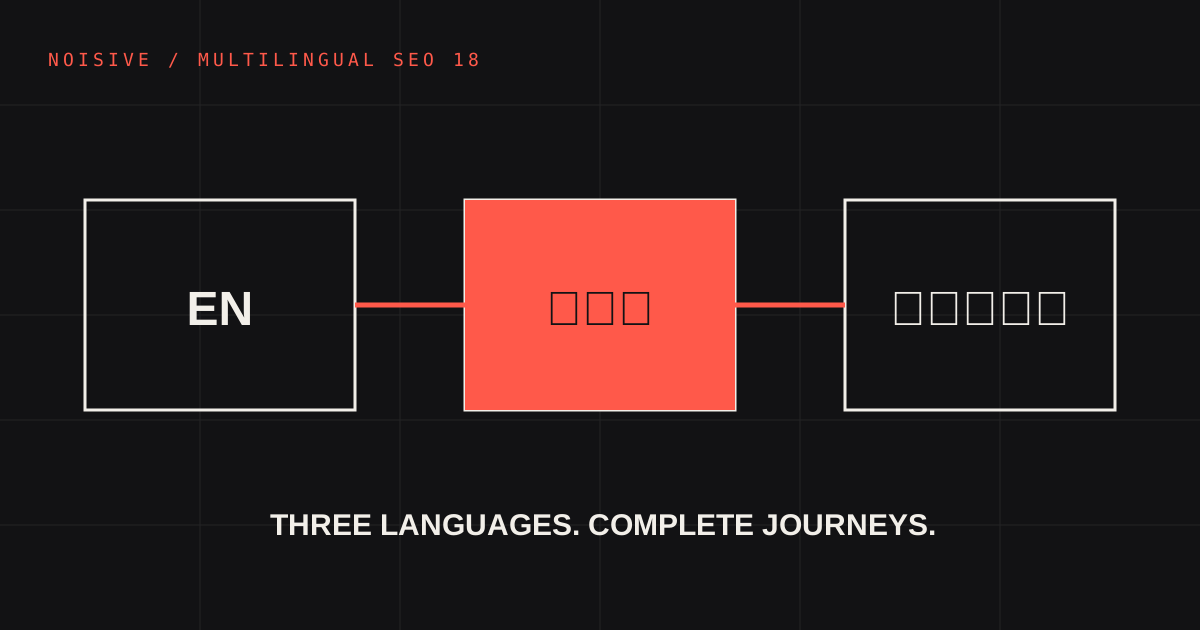
A multilingual website in Sri Lanka should give English, Sinhala, and Tamil content distinct crawlable URLs, accurate human-reviewed localisation, self-referencing canonicals, reciprocal hreflang annotations, and visible language links. Translate the complete decision journey, not isolated pages, and measure search demand, engagement, and conversion separately for each language and device.
What should you know first?
- Use a stable URL for every indexable language version.
- Add reciprocal hreflang and a self-referencing canonical to equivalent pages.
- Localise meaning, forms, proof, metadata, and support—not only interface labels.
- Give each language an owner, review cycle, and performance report.
Which URL structure works for multiple languages?
Language subdirectories such as /en/, /si/, and /ta/ are clear and manageable for many Sri Lankan organisations. Subdomains and country domains can also work, but they create different operational demands.
Google recommends different URLs for different language versions and hreflang annotations to connect them. Avoid relying only on cookies, browser language, or automatic redirection because crawlers and users may not reach every version.
How should multilingual SEO elements align?
| Element | English example | Sinhala or Tamil requirement | Common failure |
|---|---|---|---|
| URL | /en/service/ | Distinct stable equivalent URL | One URL changes by cookie |
| Hreflang | en-LK | Correct language-region code | Missing reciprocal annotation |
| Canonical | Self-reference | Self-reference | All languages canonical to English |
| Metadata | Localised title and description | Human-reviewed search language | Direct machine translation |
| Links | Visible language option | Equivalent destination | Always returns to homepage |
What should be localised beyond page copy?
- →Navigation, buttons, forms, validation, confirmations, and transactional email
- →Search titles, descriptions, image alternatives, schema text, and social previews
- →Currency, dates, numbers, addresses, names, and culturally specific examples
- →Customer evidence, support availability, legal notices, and consent language
- →Fonts, line breaking, text expansion, keyboard input, and screen-reader output
How can multilingual content stay accurate?
Assign a content owner for every language, maintain a shared source-of-truth, record translation status, and review important pages after each product, price, legal, or service change.
Do not launch a language selector that leads to incomplete journeys. If a translated service page sends users to an English-only form or policy without warning, trust and task completion fall. A smaller complete language section is usually safer than broad partial coverage.
FAQ
What do businesses ask most often?
Does a Sri Lankan website need all three languages?
Not automatically. Choose languages from audience needs, legal duties, support ability, search demand, and the capacity to maintain a complete accurate journey.
Can AI translate the whole website?
AI can support a first draft, but a fluent reviewer should check meaning, tone, terminology, legal content, interface limits, and cultural context before publishing.
Does hreflang improve ranking?
Hreflang helps search engines show the appropriate language or regional version. It does not replace content quality, crawlability, authority, or good technical SEO.
Which primary sources support this guide?
Which Noisive resources should you explore next?
Need a clear build plan?
How can your next website decision become measurable?
Noisive designs and develops websites, web applications, e-commerce experiences, and technical SEO systems for growth-focused teams.
Start a project