
Direct answer
What is the direct answer?
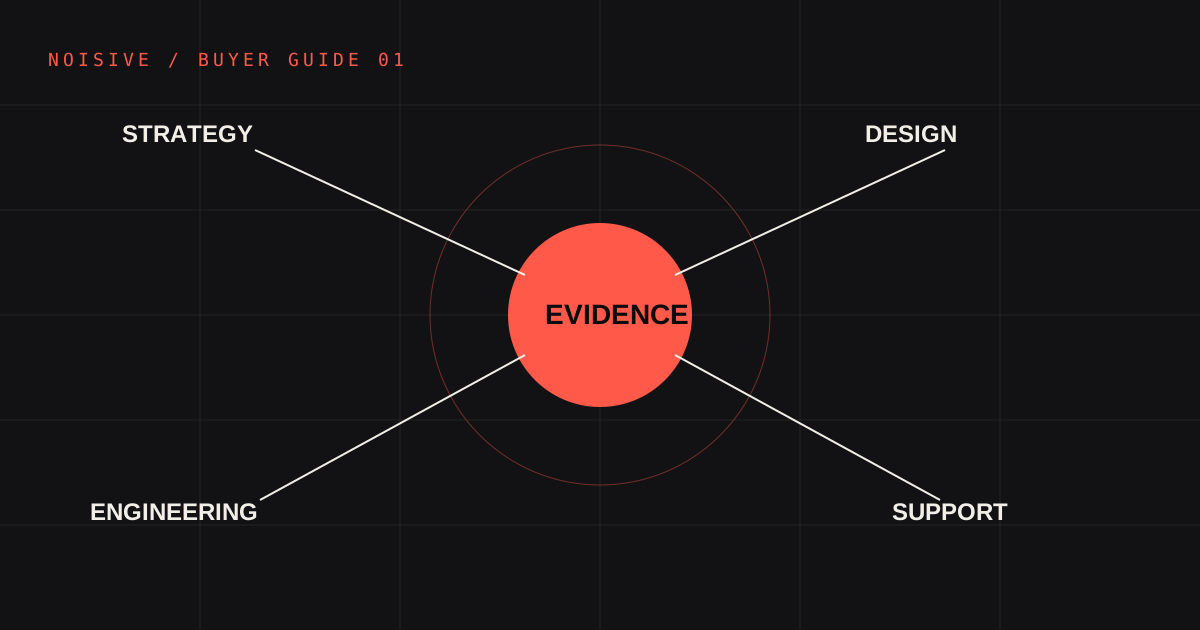
A good web development agency in Sri Lanka should connect business goals to design, engineering, search visibility, measurement, and post-launch support. Compare proof and process, not screenshots alone.
What should you know first?
- Start with the business outcome and required integrations, not a preferred platform.
- Ask for live URLs, performance data, accessibility checks, and a clear ownership model.
- Compare total cost over 24 months, including hosting, maintenance, content changes, and rebuild risk.
- Choose a team that can explain trade-offs in plain language and measure results after launch.
What should you compare first?
Compare the agency's ability to define the problem before you compare visual style. A strong discovery process should identify users, conversion actions, content needs, integrations, risks, and success metrics.
Many proposals look similar because they list pages and features. The important difference is how each team reaches those decisions. Ask what evidence supports the sitemap, how the team will test key journeys, and which result will show that the project worked.
A capable partner will also challenge weak assumptions. If a simple marketing site can solve the problem, they should not sell a complex web application. If a template will create long-term limits, they should explain those limits before work starts.
Agency evaluation scorecard
| Area | Evidence to request | Warning sign |
|---|---|---|
| Strategy | Discovery output and measurable goals | A quote based only on page count |
| Design | Responsive prototype and usability reasoning | Only static desktop mock-ups |
| Engineering | Live code quality, security, and performance proof | No staging or testing process |
| SEO | Indexation, schema, redirects, and CWV plan | A promise to rank number one |
| Support | Response times, ownership, and exit terms | Unclear access to code and accounts |
Questions to ask before signing
The quality of the answer matters more than the tool named in the answer. Look for specific steps, clear owners, and honest limits. A team that explains risk early is usually safer than one that agrees with every request.
- →Who owns the source code, domain, analytics, design files, and hosting account?
- →Which work is completed in-house and which work is outsourced?
- →How are scope changes priced and approved?
- →How will redirects, structured data, analytics, and consent be tested before launch?
- →What happens if the relationship ends or the main developer becomes unavailable?
How Noisive approaches the decision
Noisive starts with the smallest reliable solution that can meet the commercial goal, then designs the content, interface, technical SEO, and measurement system around it.
For growth-focused businesses, this often means a fast marketing website with reusable sections and a clear lead path. For teams with workflows, accounts, or complex data, it may mean a custom web application. The correct answer depends on operational needs, not fashion.
FAQ
What do businesses ask most often?
How long does a business website take in Sri Lanka?
A focused site can take two to six weeks. A larger custom website normally takes six to twelve weeks, depending on content, integrations, approvals, and testing.
Should I choose a freelancer or an agency?
Choose based on risk and scope. A freelancer can suit a small, defined project. An agency is often safer when strategy, design, development, SEO, integrations, and ongoing support must work together.
What should be included in the proposal?
The proposal should state scope, deliverables, exclusions, milestones, payment terms, ownership, support, acceptance criteria, and how changes are managed.
Need a clear build plan?
How can your next website decision become measurable?
Noisive designs and develops websites, web applications, e-commerce experiences, and technical SEO systems for growth-focused teams.
Start a project