
Direct answer
What is the direct answer?
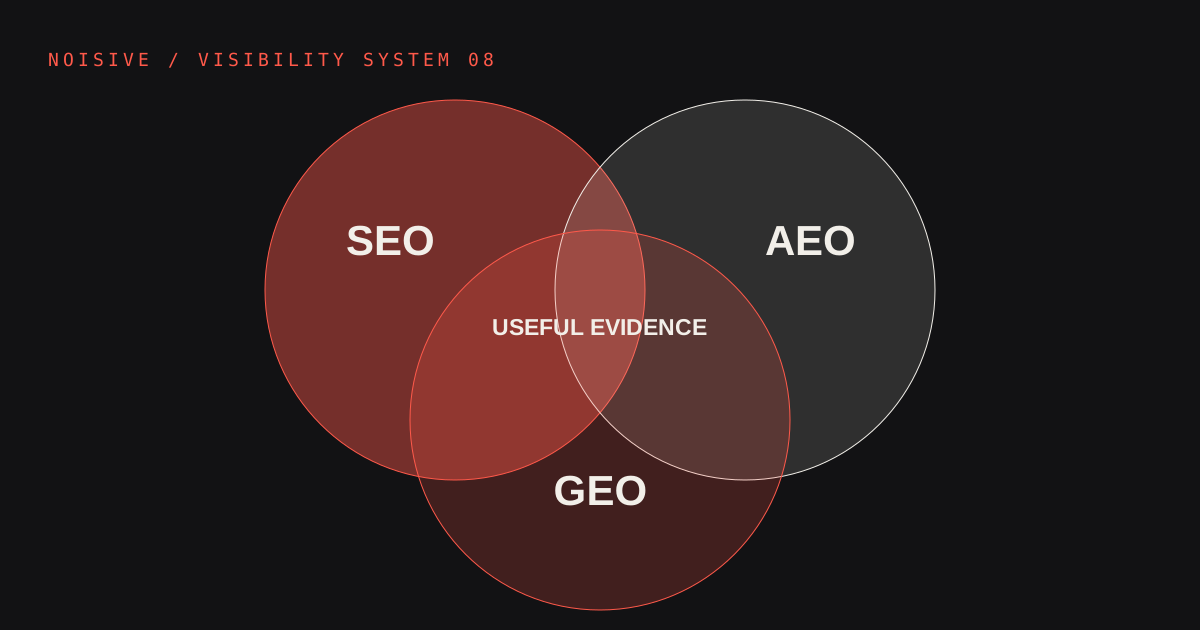
SEO improves discovery and ranking, AEO makes answers easy to extract, and GEO increases the chance that generative systems retrieve and cite a source. All three depend on accessible pages, clear entities, useful evidence, and authority.
What should you know first?
- Do not create three separate content programmes; improve one canonical source for several retrieval surfaces.
- Write direct answers, then support them with evidence, limits, examples, and clear authorship.
- Allow relevant search crawlers and keep important facts in server-rendered HTML.
- Measure cited mentions and assisted conversions, not only blue-link rankings.
How the three disciplines differ
| Layer | Main job | Useful signals |
|---|---|---|
| SEO | Earn qualified discovery in search results | Relevance, links, architecture, performance, satisfaction |
| AEO | Provide a direct, reliable answer | Question match, concise answer, lists, tables, definitions |
| GEO | Become a retrievable and citeable source | Entity clarity, evidence, freshness, corroboration, passage quality |
Build passage-level usefulness
Give each section one clear question, a short answer that stands alone, and supporting detail. Name the subject instead of using unclear pronouns, and place units, dates, locations, and limits beside each fact.
Retrieval systems often select a passage rather than a whole page. A precise section can be useful even when the full article covers a broad subject. Descriptive headings, stable anchors, short paragraphs, and simple tables improve both scanning and extraction.
This is not permission to repeat keywords. Natural language with clear entity relationships is more useful than forced phrases. Write the exact answer a buyer needs, then show how you know.
Technical access for AI search
- →Allow OAI-SearchBot when you want content considered for ChatGPT search summaries.
- →Allow PerplexityBot when you want full content available to Perplexity's index.
- →Keep XML sitemaps current and link every important page from crawlable HTML.
- →Use canonical tags and stable URLs so citations do not split across duplicates.
- →Track AI referrals with source and landing-page reports, while accepting that some citations may not send a click.
What not to do
Do not publish large volumes of generic summaries. They add little information gain and are easy for an answer engine to replace. Do not use unsupported schema or hide answer text only inside scripts. Do not invent research, clients, awards, or performance results.
The durable strategy is harder but clearer: publish original observations, show methods, earn independent mentions, keep facts updated, and make every claim easy to verify.
FAQ
What do businesses ask most often?
Is GEO replacing SEO?
No. Generative systems still depend on discoverable, relevant, trusted sources. Strong technical SEO and content quality support both traditional and AI search visibility.
Does llms.txt guarantee AI citations?
No. It can offer a clean summary and preferred URLs, but major search systems do not promise ranking or citation benefits from the file.
How can I measure GEO performance?
Track AI referral traffic, landing pages, cited-domain tests for priority prompts, branded search growth, unlinked mentions, assisted leads, and the share of answers that include your brand.
Which primary sources support this guide?
Need a clear build plan?
How can your next website decision become measurable?
Noisive designs and develops websites, web applications, e-commerce experiences, and technical SEO systems for growth-focused teams.
Start a project