
Direct answer
What is the direct answer?
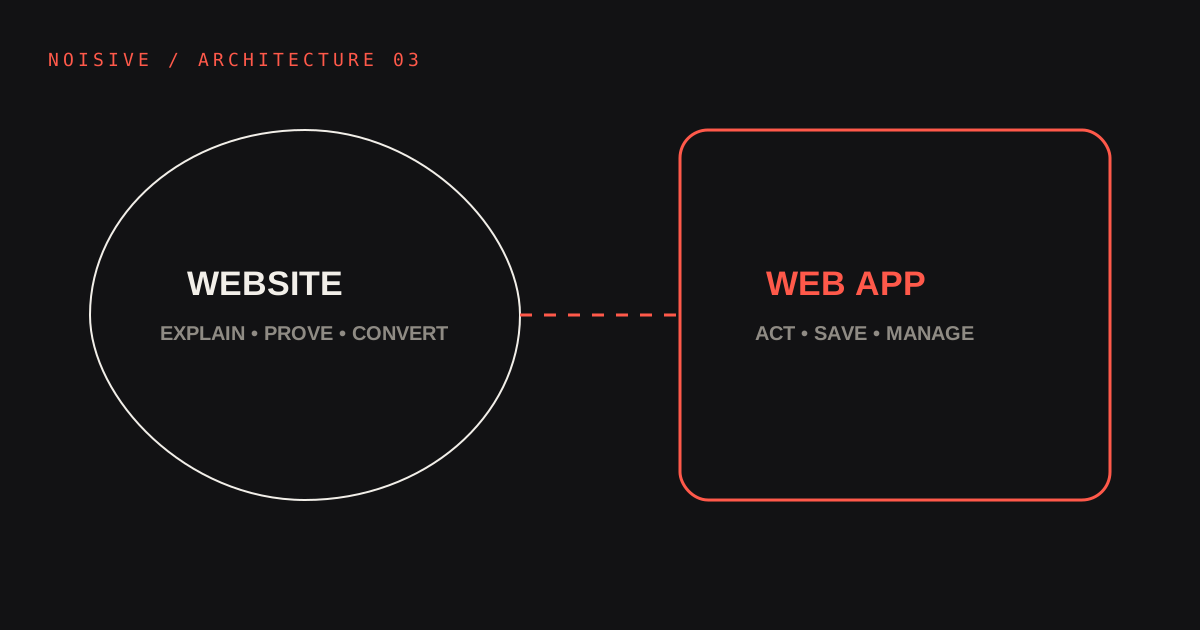
A business website mainly explains, proves, and converts. A web application lets users complete ongoing tasks, manage data, or follow a workflow. Some products need both layers.
What should you know first?
- Choose a website when the main goal is discovery, trust, content, and enquiries.
- Choose a web app when users need accounts, saved data, permissions, or repeated workflows.
- Validate the workflow before funding a large custom build.
- Keep public marketing content crawlable even when the product sits behind a login.
The practical difference
| Signal | Business website | Web application |
|---|---|---|
| Main action | Read, compare, enquire, buy | Create, manage, calculate, collaborate |
| User identity | Usually optional | Often required |
| Data | Mostly published content | User-specific and changing data |
| Complexity | Content and presentation | Rules, states, security, and workflows |
| SEO role | Primary acquisition surface | Usually supported by public landing pages |
Four questions that decide the architecture
If most answers are no, a well-built website or simple form integration may be enough. If several answers are yes, the project needs application architecture, data modelling, authentication, security review, and more testing.
- →Must the system remember something for each user?
- →Do different people need different permissions or views?
- →Does the product replace a repeated manual process?
- →Would failure create financial, privacy, or operational risk?
When you need both
Many SaaS and service companies need a fast public website for acquisition and a separate application for customer work. The two should share a brand system but have different performance and security priorities.
The marketing layer must be easy to crawl, quick to change, and clear to first-time visitors. The product layer must protect data and make repeated tasks efficient. Trying to force both into one tool can make each side weaker.
Start with a thin first release
Map the riskiest user journey, build the smallest complete version, and measure real use. Avoid building an admin panel, complex roles, and automation before the core workflow proves useful.
A short discovery phase can produce a process map, data model, clickable prototype, technical plan, and phased estimate. Those outputs reduce cost because they expose unclear rules before engineering begins.
FAQ
What do businesses ask most often?
Is an e-commerce store a website or a web app?
It is usually both. Public category and product pages act like a website, while carts, accounts, payments, and order management behave like an application.
Does a web application need SEO?
Its private screens usually do not. The public website, documentation, use-case pages, and help content still need SEO to attract and educate buyers.
Can a website become a web application later?
Yes, when the content layer, design system, hosting, and technical architecture allow planned expansion. Define likely future workflows during discovery.
Need a clear build plan?
How can your next website decision become measurable?
Noisive designs and develops websites, web applications, e-commerce experiences, and technical SEO systems for growth-focused teams.
Start a project