
Direct answer
What is the direct answer?
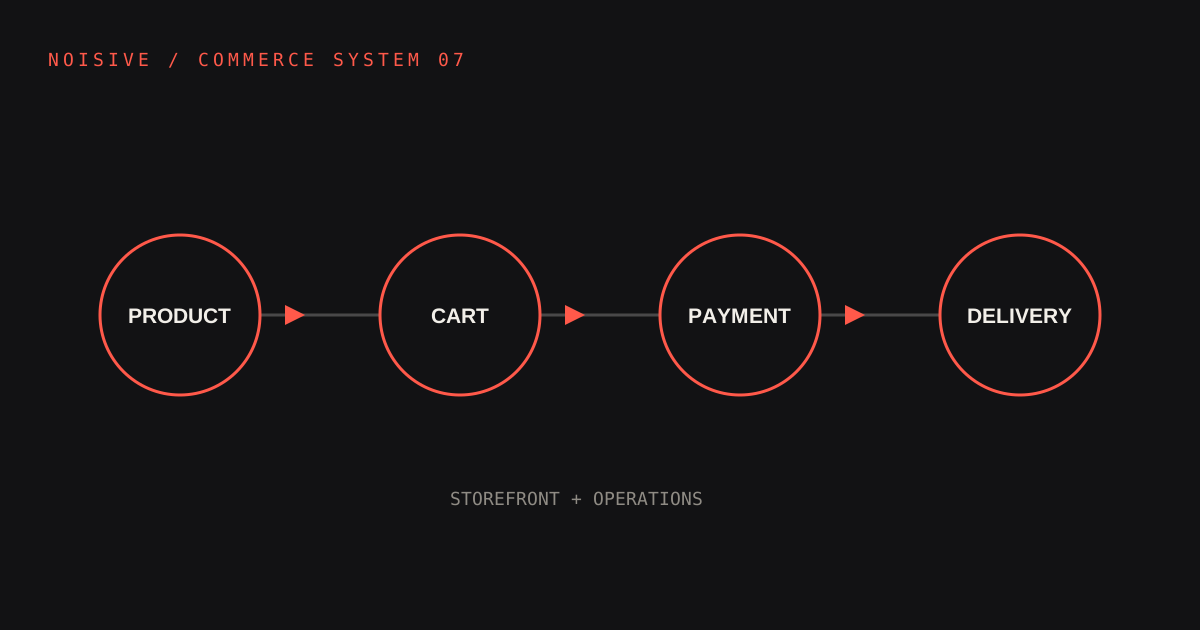
E-commerce development combines a public product catalogue with payments, stock, fulfilment, customer communication, analytics, and search visibility. The operational workflow matters as much as the storefront.
What should you know first?
- Map order handling, stock ownership, delivery zones, returns, and support before choosing a platform.
- Design for mobile networks, local payment expectations, and clear total costs.
- Keep product data structured and unique so search and AI systems can understand it.
- Track product views, add-to-cart, checkout steps, purchases, refunds, and failed payments.
The brief must start behind the screen
A beautiful shop can still fail if staff must copy every order into several systems. Document the current process and the desired process. Then decide which steps should be integrated, automated, or kept manual in the first release.
- →Who creates products and controls price changes?
- →Where is stock recorded, and how quickly must it sync?
- →Which districts, countries, and delivery rules are supported?
- →How are failed payments, cancellations, returns, and exchanges handled?
- →Which team receives order alerts and customer questions?
Platform decision guide
| Option | Good fit | Main trade-off |
|---|---|---|
| Hosted commerce | Fast launch and standard retail | Platform and customisation limits |
| WooCommerce | Content-heavy stores with familiar editing | Plugin, security, and performance upkeep |
| Headless commerce | Custom experience and several channels | Higher build and operational complexity |
| Custom commerce | Unique rules that create business advantage | Highest testing, security, and support need |
Product pages that serve people and machines
Each product page needs a unique name, short direct summary, price and availability, clear variants, delivery and returns, useful images, specifications, proof, and valid Product structured data that matches the visible page.
Avoid supplier descriptions repeated across many stores. Add measurements, compatibility, use cases, care guidance, local delivery facts, and original photography. This content helps shoppers decide and gives retrieval systems specific facts to cite.
Launch metrics
- →Product-list view to product-view rate
- →Product-view to add-to-cart rate
- →Checkout start, address, payment, and purchase completion
- →Payment failure by method and device
- →Revenue, margin, refund rate, repeat orders, and support contacts
FAQ
What do businesses ask most often?
Which payment gateway should a Sri Lankan store use?
Choose from gateways that support your bank, settlement needs, currencies, payment methods, security process, refunds, and technical platform. Confirm current fees and approval requirements directly.
How much does an e-commerce website cost in Sri Lanka?
A standard store may start around LKR 250,000, while large catalogues, custom design, integrations, and complex operations can raise the cost well above LKR 1,000,000.
Does every product need Product schema?
Use Product markup on pages about a specific product or valid variant. The structured price, stock, reviews, and identifiers must match visible content and real availability.
Need a clear build plan?
How can your next website decision become measurable?
Noisive designs and develops websites, web applications, e-commerce experiences, and technical SEO systems for growth-focused teams.
Start a project